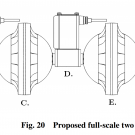
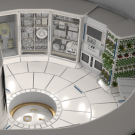
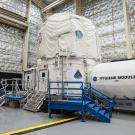
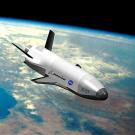
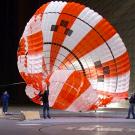
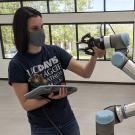
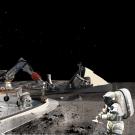
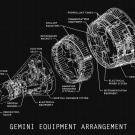
The Astronaut-Powered Laundry Machine is a stand-alone machine designed to convert human power into other forms of power for doing laundry across a variety of spaceflight environments (e.g., Low Earth Orbit, Lunar Surface). Performing laundry during a space mission would reduce the logistical burden of throwing away dirty garments and bringing replacement garments. Exercise is used to power the machine because there is minimal impact on crew time. The water treatment and agitation technology developed under the project may promote more sustainable laundry practices on Earth.
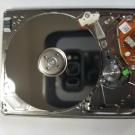
Repurposed hard disk drives can be used for small satellite attitude control, promising to reduce the cost for CubeSats that require three-axis pointing.
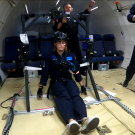
The CHANGES team is validating a novel technology to serve as a non-pharmaceutical countermeasure to Space Adaptation Sickness by testing in microgravity conditions aboard parabolic flights.
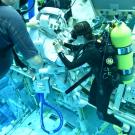
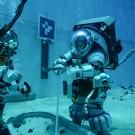
Our lab collaborated with NASA's Johnson Space Center (JSC) to design and test an extravehicular activity (EVA) spacesuit helmet-mounted display (HMD) to enhance astronaut situational awareness during underwater EVA training.
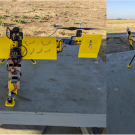
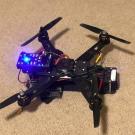
This project aims to develop the first agricultural drone that can take off like a helicopter, transition to wing-supported high-speed flight like an airplane, and then land like a helicopter.
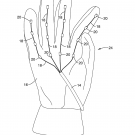
A passive mechanical system was developed as a proof-of-concept to test the feasibility of an unpowered exoskeleton to maintain static grip of an inflated pressure suit glove around an object.