


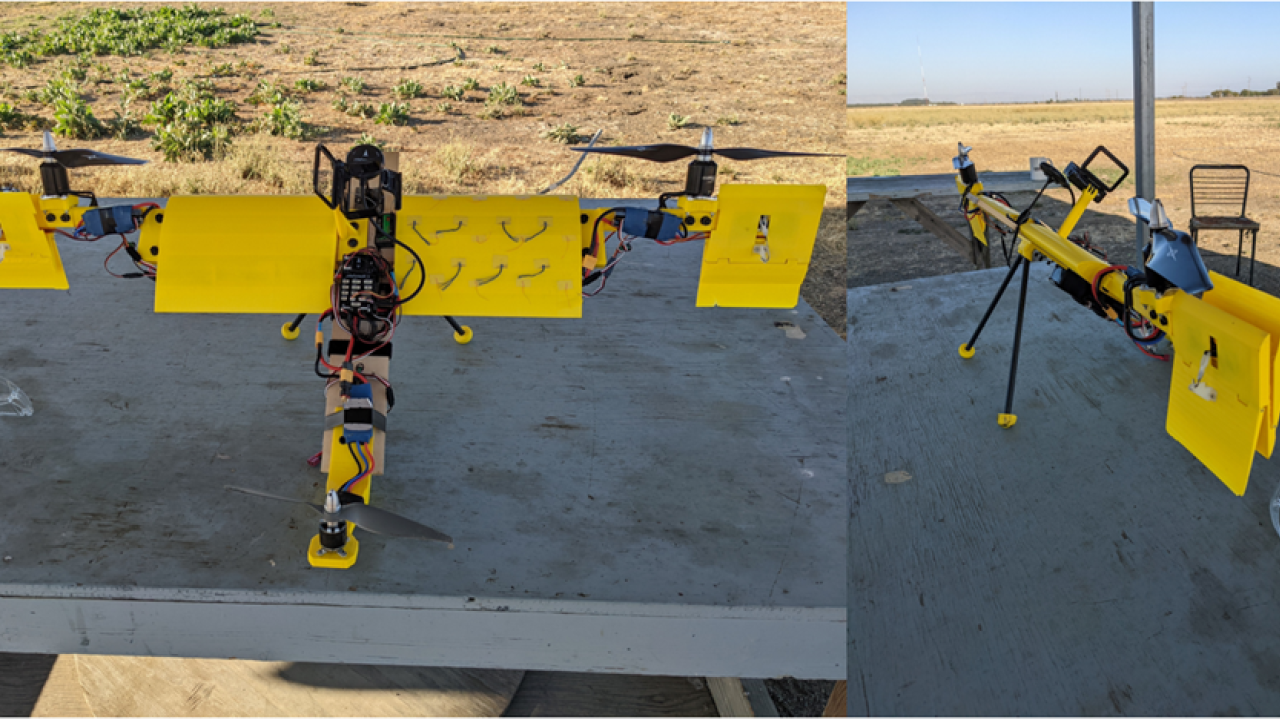
Tilt-Wing Tri-copter for Ag Air-Data Sampling
Problem Description
Fixed-wing aircraft have greater endurance than quadcopters, but require more open space to takeoff and land, which restricts the spaces in which they can operate. To visit multiple sites that are far apart, yet have an abundance of obstacles, an UAV that can perform vertical take-off and landing, then transition to forward flight would be ideal.
Research Aims
We are striving to develop the first agricultural drone that can take off like a helicopter, transition to wing-supported high-speed flight like an airplane, and then land like a helicopter. In between flights, the drone will sample the air at ground level within an orchard or field while consuming very little battery power. The goal is to verify the concept design of a tilted-frame UAV for precision agriculture. The tilted frame is designed to have two types of flying modes: vertical and horizontal (cruise) flight. The vertical take-off and landing (VTOL) capability enables the UAV to land between trees for sample gathering and takeoff to bring the sample back for health diagnosis. And horizontal flight enables longer distance travel and flight time compared to stand multi-copter. The basic design has been validated and the current research is focused on the control of the transition from the vertical flight mode to horizontal flight.
Associated Students
- Ilya Anishchenko
- Tony Chao
Associated Publications
- Design, Development, and Validation of a High-Performance Tilt-Frame Unmanned Aerial System for Landing in Tree Orchards - MS Thesis - 2018
- Advanced Tilted-Airframe Unmanned Aerial Vehicle Transition Control and Cruise Performance Analysis - MS Thesis - 2023