


Algebraic Modeling for Cockpit-Computed Wake Vortex Avoidance Guidance
Problem Description
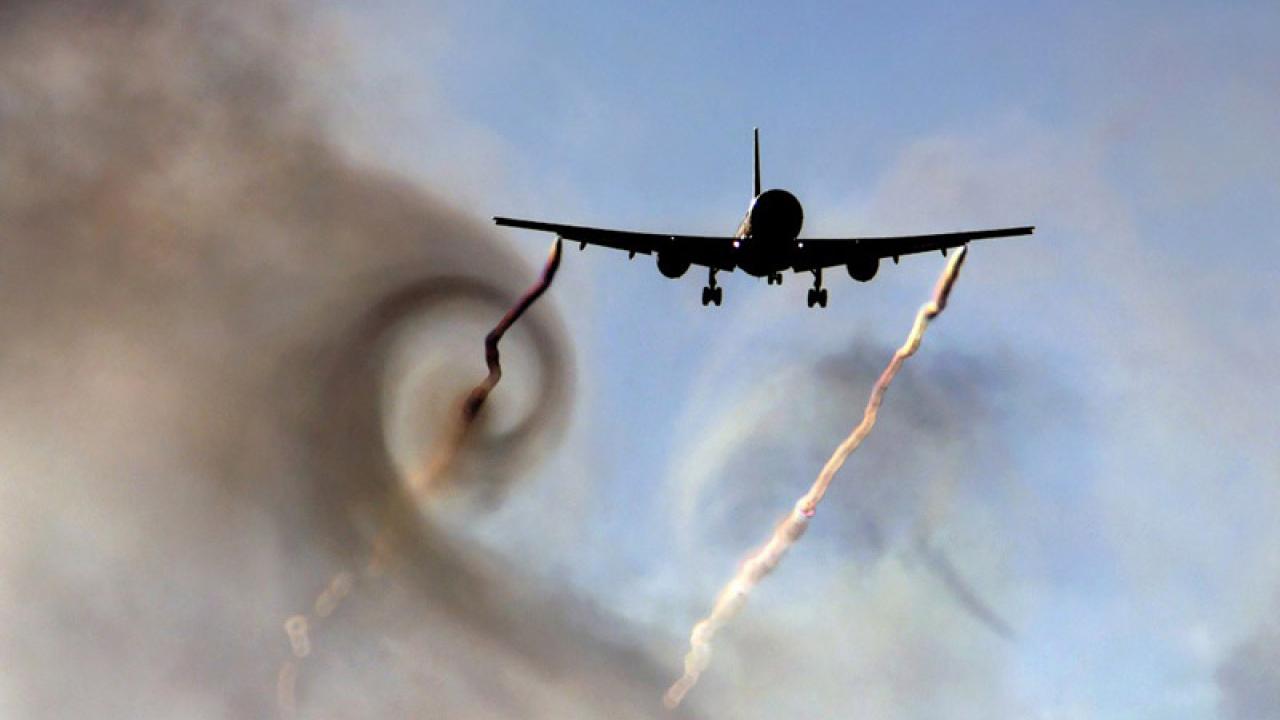
As aircraft wings generate lift, a high-pressure region develops on the underside of the wing and a low-pressure region on the topside. This imbalance results in vortices trailing behind the aircraft; these typically invisible disturbances (sometimes made visible by fog or smoke, as shown in the above image) can persist after the aircraft has gone, resulting in turbulence for any other aircraft that flies through. Understanding the magnitude and lifespan of these vortices results in safer flight, especially as airspace becomes more crowded.
Research Aims
By simulating the vortex generation occurring on an aircraft wing, how these vortices spread outward and trail behind the aircraft can be better understood. Furthermore, by understanding how the vortex behavior changes depending on factors like air density and temperature or aircraft speed and size, we can predict the presence of vortices once an aircraft has left an area, informing other aircraft to avoid turbulence.
Associated Students
- Guy Schauerhamer
Associated Publications
- Simulating Aircraft Wake Vortices with OVERFLOW, AIAA Applied Aerodynamics, 2015
- Sensitivity Study of Aircraft Wake Vortices Using OVERFLOW, AIAA Atmospheric and Space Science, 2016
- A validation study of overflow for wing-tip vortices, AIAA Aerospace Sciences, 2016
- Towards Simulating the Evolution of Aircraft Wake Vortices with OVERFLOW, AIAA Aerospace Sciences, 2017
- Aircraft effects in wake vortex decay simulations, AIAA Applied Aerodynamics, 2017
- Computational-fluid-dynamics best practices for aircraft wing-tip vortex roll-up, Journal of Aircraft, 2017
- Simulating the Lifecycle of Aircraft Wake Vortices, PhD Dissertation, 2017