


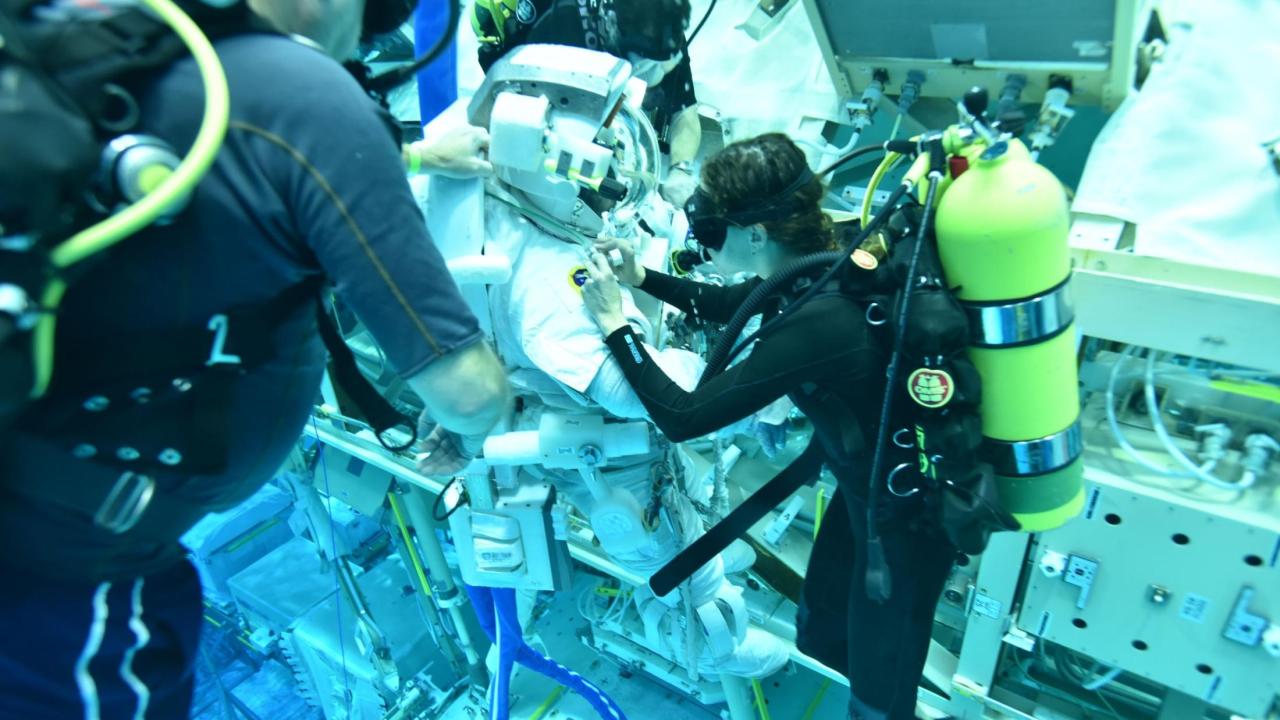
Helmet Mounted Display Development for Spacewalk Underwater Training
Problem Description
During extravehicular activities (EVA), astronauts have a high cognitive load: performing advanced procedures while communicating on multiple audio channels in a physically-strenuous, life-threatening environment. An unobtrusive display could help astronauts keep track of information and reduce their mental workload, but using such a display in the constraints of the spacesuit is challenging.
Research Aims
Our lab collaborated with NASA's Johnson Space Center (JSC) to design and test an EVA spacesuit helmet-mounted display (HMD) to enhance astronaut situational awareness during underwater EVA training. An EVA HMD will enable astronauts to monitor and react to real-time information including physiological biometrics, spacesuit status, environmental factors, task procedures, and navigation aids. To meet operational EVA challenges, HRVIP partnered with the JSC’s Human Physiology, Performance, Protection, and Operations (H-3PO) Lab to create HMD prototypes and test them during underwater EVA training in JSC’s Neutral Buoyancy Laboratory (NBL) in 2020-2022. Feedback from these HMD evaluations will inform future heads-up displays, both for EVA training and for the next-generation spacesuit.
Associated Students
- Janine Moses
- Daniela Davalos
- Ruby Houchens
Associated Publications
- Helmet-Mounted Display Technology for EVA Training in NASA's Neutral Buoyance Lab, ICES, 2021