


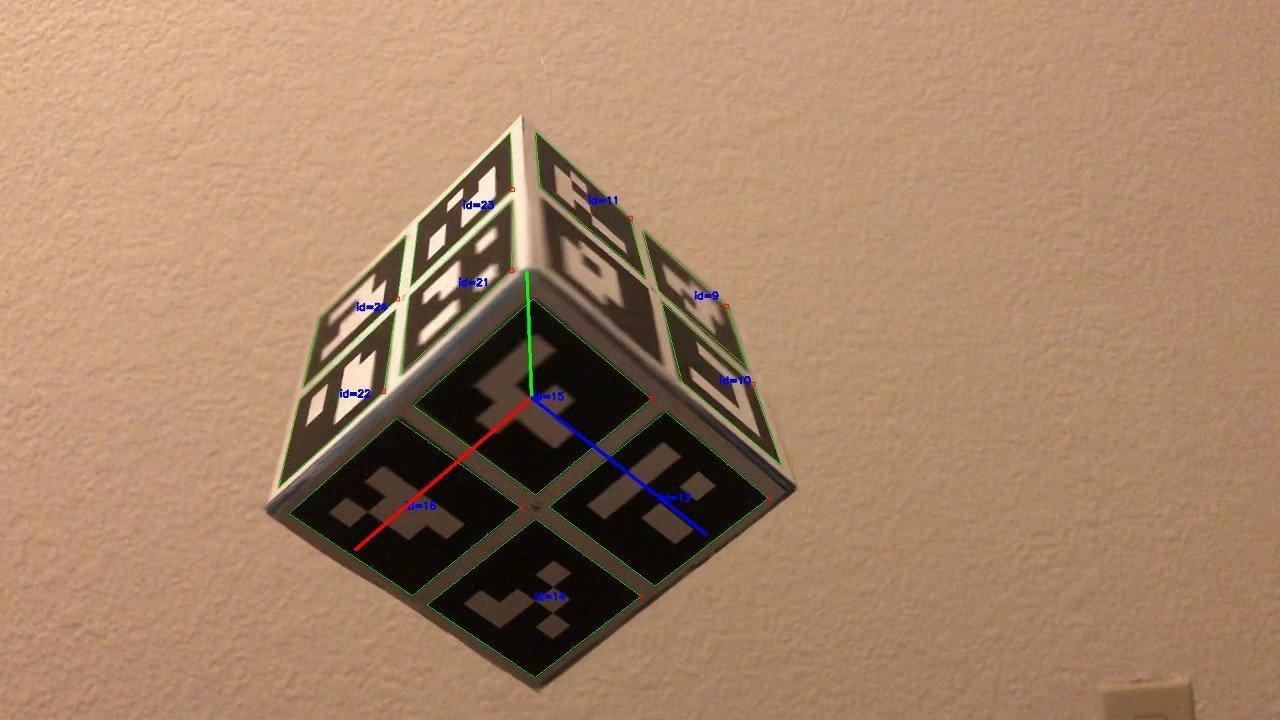
Fiducial Markers for CubeSat Pose Estimation
Problem Description
Using cameras and computer vision to measure an object's position and orientation has a myriad of uses, both in the laboratory and for deployment in the field. To use a camera in this way, first landmarks in the image must be recognized and then the geometry of those landmarks are used to calculate the pose of the camera.
Research Aims
We have used pose estimation in primarily two contexts for satellite-related research.
- The first context is measuring position or rotation during experiments to create a "ground-truth" to compare against. For example, we used several cameras to measure the rotation of our CubeSats during Zero-G parabolic flights to show that the hard disk drive reaction wheels were controlling the satellite's rotation as intended. This project used Aruco tags (a type of fiducial marker, shown in the photo above) printed on the CubeSats. We also plan to use this approach to measure the motion of objects on our float table for similar experiments.
- The second context is for the inspection satellite to estimate its own pose while maneuvering around a target spacecraft. Since the target does not have fiducial tags, a different type of landmark needs to be used. We are currently researching if handrails can be used for this task, with algorithms like SoftPOSIT to calculate the pose.
Associated Students
- Melanie Stitch
- Abhay Negi
- Kylie Cooper
- Matthew Norman
- Adam Zufall
Associated Publications
- Computer Vision for Dual Spacecraft Proximity Operations, MS Thesis, 2015
- Computer Vision System and Experimental Design for Parabolic Flight Demonstration of Hard Disk Drives as CubeSat Reaction Wheels, MS Thesis, 2023
- Enabling Technologies for a Low-Cost, Deployable Inspection Satellite, AIAA SciTech, 2026