


Cold Gas Low-Risk Propulsion System Design
Problem Description
The valves controlling a cold gas propulsion system have two failure states: fail on (open) or fail off (closed). The former can be disastrous if two spacecraft are operating in close proximity, since uncontrolled release of propellant could cause a collision. Added redundant values is possible, but adds mass, complexity, and increases the risk of the second failure mode.
Research Aims
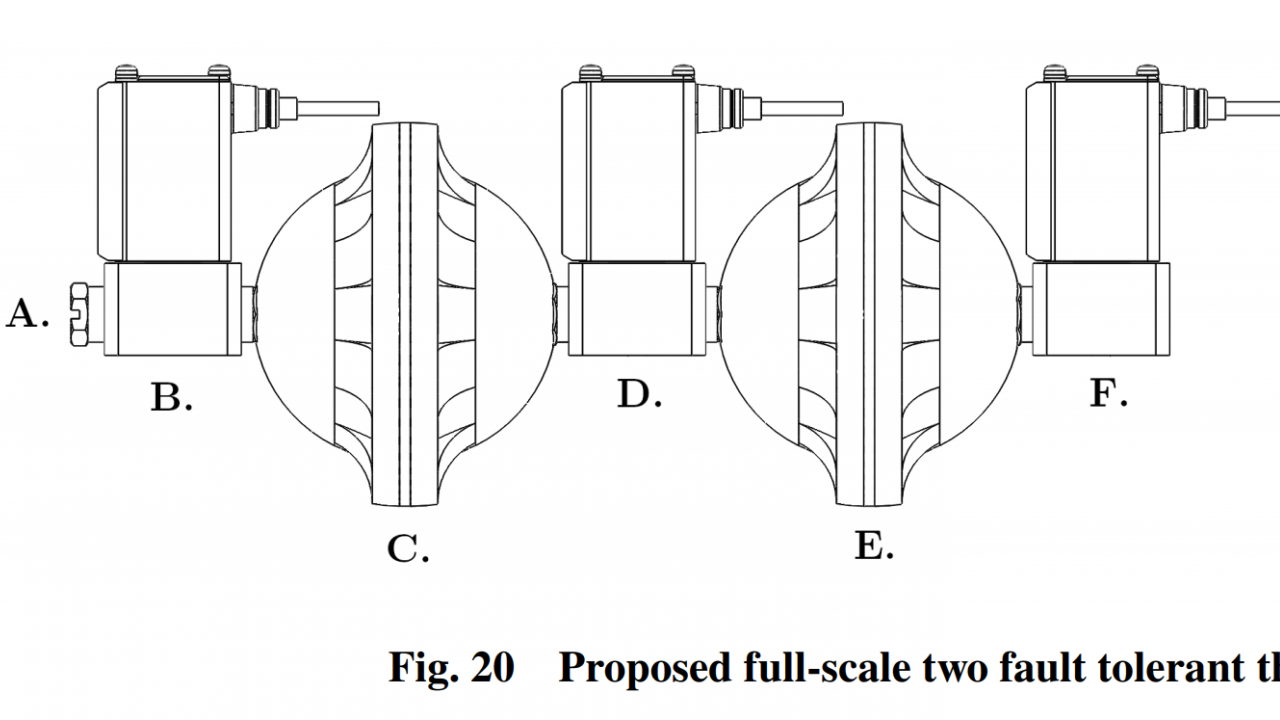
This research project consisted of designing, fabricating (with additive manufacturing), and testing a cold gas propulsion system. This propulsion system used nested plenums, pressure vessels of fixed volume, to contain a subset of the propellant; if the final valve failed, only the propellant in the last plenum would be lost, resulting in a manageable disturbance to the spacecraft. Furthermore, by nesting plenums within one another, the total mass and volume of the system is decreased, allowing for the redundant set of valves to be installed in small systems, such as an inspection CubeSat.
The project also included the creation of an air bearing table to demonstrate the behavior of the cold gas system.
Associated Students
- Josh Day
- Cordell Cohoon
- Lily Figueroa
Associated Publications
- Development of a Two-Fault Tolerant Cold Gas Propulsion System and Air Bearing Testbed for Application to a Spacecraft-Inspection CubeSat, MS Thesis, 2020
- Two-fault tolerant cold gas propulsion system for spacecraft-inspection CubeSat, AIAA SciTech, 2020
- Enabling Technologies for a Low-cost, Deployable Inspection Satellite, AIAA SciTech, 2026