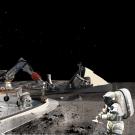
Improving manual teleoperation of robotic arms in space (such as the Canadarm2) using advanced control and feedback devices, enabling safe Earth-independent human-systems operations.
This project aims to develop the first proof-of-concept exploring manual in-EVA (extravehicular activity) control of a remote robot. An ergonomic grip design is developed which minimizes fatigue without compromising operational ability. A human subject study is performed exploring differences in human behavior when controlling a remote robot with two different control devices.
Maintaining a "digital twin" enables prognostics to better understand and predict the behavior of a complicated physical system. This is especially valuable in spaceflight applications, where the system is often bespoke and failure has high consequence.